Recently in vision Category
http://www.huffingtonpost.com/2011/08/02/best-electron-microscope-images_n_916275.html
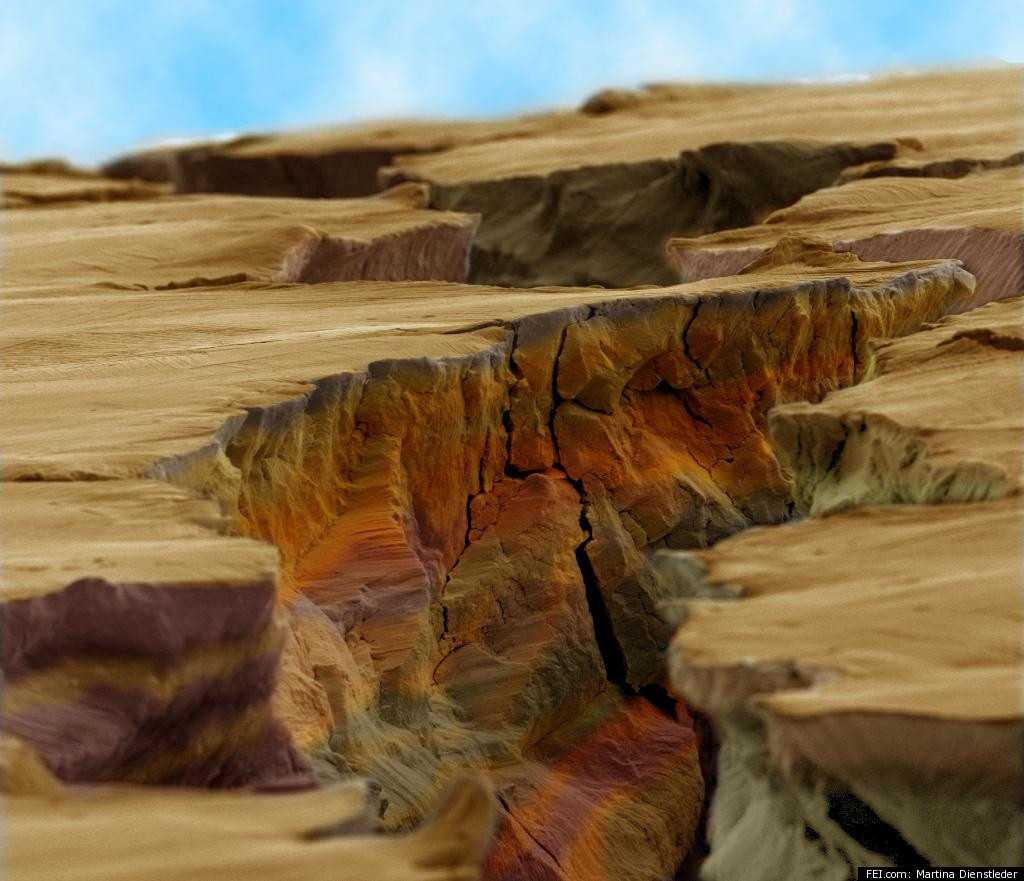
The Microcanyon was taken with a microscope from FEI's Nova DualBeam Family, unlike the other two which were taken with microscopes from the Quanta family. The Quanta microscope was also used to take this image of a hydrothermal worm that rocked the internet.
This year's winner, however, was taken at an extremely high magnification, with a width of just 67µm, making it more than what it seems. In reality it's a micro-crack in a piece of steel, taken after multiple bending tests.
http://poseidon.sunyopt.edu/BackusLab/Helmholtz/
The Optical Society of America's Southall (1924) translation of Hermann von Helmholtz's Treatise on Physiological Optics (1910) is offered here for free download from the Graduate Center for Vision Research at the SUNY College of Optometry. The pages were originally scanned for Professor Benjamin Backus in 2001 by the University of Pennsylvania.
The Optical Society of America's Southall (1924) translation of Hermann von Helmholtz's Treatise on Physiological Optics (1910) is offered here for free download from the Graduate Center for Vision Research at the SUNY College of Optometry. The pages were originally scanned for Professor Benjamin Backus in 2001 by the University of Pennsylvania.
The page images in the PDF files are of excellent quality, but you may find they are too large to view using your web browser. We suggest you download them (e.g. right click and "save as") and then view them on your computer. The smaller DjVu version may be more convenient: download the zip archive, extract it to a folder, and then open the file "directory.djvu" using a DjVu viewer.

The optical character recognition (OCR) in the DjVu and PDF files are useful for searching. Alas, the OCR is not of high quality and you may not find all instances of your target word(s). We would be delighted should you see fit to make and share a cleaner copy of the text.
Volume III begins with a discussion of perceptual inference. This is where most students of perception will want to start.
Happy reading!

Some blind people are able to use the sound of echoes to "see" where things are and to navigate their environment. Now, a new study finds that these people may even be using visual parts of their brains to process the sounds.
http://news.yahoo.com/s/livescience/20110525/sc_livescience/blindpeopleseeshapesnavigateusingechoes
(Thanks to Melissa for sending)
This person is either David Hubel or Torsten Wiesel and has an anesthetized cat with it's eyes pointed toward this screen. An electrode is placed in the occipital cortex in the first part of the neocortex that receives visual information from the eyes via the thalamus. This electrode picks up the electrical signal of an action potential, which signifies the information that a particular neuron in this area is passing on to other neurons.
Here are more cool videos: http://www.youtube.com/watch?v=VPQAtkxn3tY&feature=related
"You'd be able to literally see all around you, including behind yourself, and zooming in at will, creating a "stereoscopic/binocular system, simultaneously providing 10x zoom to both eyes." And you would do this all hands-free, apparently by barking out or pre-programming a command (the solicitation leaves it up to a designer's imagination) to adjust focus."
http://www.wired.com/dangerroom/2010/12/pentagon-wants-to-give-troops-terminator-vision/

TRICKS OF THE EYE, WISDOM OF THE BRAIN
Most people assume that what you see is pretty much what your eye sees and reports to your brain. In fact, your brain adds very substantially to the report it gets from your eye, so that a lot of what you see is actually "made up" by the brain (see Seeing more than your eye does).
http://serendip.brynmawr.edu/bb/latinhib.html
.GIF)
Most people (even many who work on the brain) assume that what you see is pretty much what your eye sees and reports to your brain. In fact, your brain adds very substantially to the report it gets from your eye, so that a lot of what you see is actually "made up" by the brain.
http://serendip.brynmawr.edu/bb/blindspot1.html

Also see : http://serendip.brynmawr.edu/bb/blindspot/
for an Applet that allows you to map you blind spot.

What does a lab in psychophysics look like? What is Matlab (see General implementation issues at the bottom of her page)? Can you find other labs on the interent that provide details about their lab?
http://www.staff.ncl.ac.uk/j.c.a.read/index.php?location=research&sub=labsetups
Also see Snapshots from the Read's lab:
http://www.staff.ncl.ac.uk/j.c.a.read/index.php?location=research&sub=pictures

This section of my website arose indirectly from my participation in the MP-scientist pairing scheme. I was asking my MP, Dave Anderson, what he was interested in getting out of his visit to my lab, in order to plan a schedule for him. He said he was mainly interested in understanding what a scientist would do all day -- "I mean, not trying to be funny, but for all I know you just sit around waiting for a bright idea." So I thought people might find it interesting if I tried to give an idea of how I actually spend my time. Here are a few examples of things I might do during a day. I wouldn't actually get anything like all of these done in a single day! -- some of them would take several hours just on their own.
http://www.staff.ncl.ac.uk/j.c.a.read/index.php?location=misc&sub=daylife

A comprehensive study of road safety (Treat et al., 1977) found that human error was the sole cause in 57% of all accidents and was a contributing factor in over 90%. In contrast, only 2.4% were due solely to mechanical fault and only 4.7% were caused only by environmental factors. Other studies have reported similar results.
http://www.visualexpert.com/Resources/roadaccidents.html

Have a look at this site and gain a better appreciation of eyes. Consider doing your own dissection. Contact your local butcher and see if they have any extras laying around.
http://www.exploratorium.edu/learning_studio/cow_eye/index.html

We'll start with a simple brain (or a simple computer) which consists of four simple elements connected as shown to the left. The bottom two ovals we'll call "input" units and the filled circle we'll call an "output" unit. They are actually all we really need (for present purposes), but things will work a little better if we have a fourth "bias" element, the circle with the B in it.
http://serendip.brynmawr.edu/complexity/perceptron/learning.html

Most people assume that what you see is pretty much what your eye sees and reports to your brain. In fact, your brain adds very substantially to the report it gets from your eye, so that a lot of what you see is actually "made up" by the brain
http://serendip.brynmawr.edu/bb/latinhib.html
You will hve to go about half of the way down this page to find the eye section. This is a lay description of how something like an eye can evolve.
http://www.abarnett.demon.co.uk/atheism/evolution.html


British inventor Josh Silver, a former professor of physics at Oxford University, has come up with a game-changer of a product design with his water-lensed glasses.
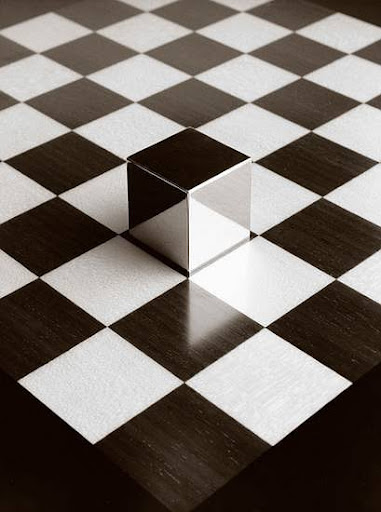
One way we can learn about how effortlessly the brain seemingly separates objects out from a visual scene is to examine how the brain has difficulty doing so. Can you see the man in the picture below? More.

Continue reading Can you see him?.
Ever wiggle a pencil in front of your eyes and it appears to be bending? This is result of our visual system having a limitation on the sampling rate speed it has. Remember that vision is a neural activity and neurons have to go through a very brief refractory period before they can fire again. If our sampling rate were higher, this is how something as simple as a rain drop would look - this is very cool!
And if you want, go this site that has a water drop synthesizer. Notice how you can change the frequency, variability, and number of drops to make it sound like a sink, bath-tub, or rain...
Continue reading Sampling rate limits what we can see.....
Recent Comments